
Disponible en castellano, inglés y euskera
Permiso de corporeidad caducado y nuestra existencia respecto al topless
Un artículo de opinión de elenamuac
Contacta con Elena por mail: elenaborrego2373l@gmail.com

Nuestra piel es la puerta al mundo y nuestro cuerpo nuestro pasaporte para habitarlo. ¿Qué pasa cuando se nos caduca el permiso de corporeidad? ¿Qué ocurre cuando la patrulla de la mirada masculina ocupa tanto espacio que se decide deportar cuerpos de la panorámica estética vital? ¿Cuánta fianza debemos de pagar para que nuestros cuerpos salgan de las cárceles mentales patriarcales? ¿Cuánta condena nos queda por cumplir? ¿De qué delito se nos acusa?
Es increíble la cantidad de preguntas que le pueden asaltar a una mientras extiende la toalla en cualquier playa. Y una mira la extensión del mar y la marea le trae más dudas. ¿Alguna vez os habéis preguntado cuándo empezaron a bañarse las mujeres en el mar? Pero más que las mujeres, sus cuerpos. ¿Cuándo se nos concedió el permiso de habitar con estos los márgenes de lo terrestre? Al mencionar los márgenes visualizo los límites de los mapas que separan los continentes del mar y eso me lleva a pensar que no es casualidad que en los mapas medievales los monstruos marinos tuvieran forma de mujer. ¿Qué puede aterrorizar más a los hombres que el cuerpo de las mujeres habitando lo desconocido, yendo allá donde ningún hombre se ha adentrado? Irónicamente, la primera vez que nos visualizaron y que, por tanto, existimos en el medio acuático fue con la demonización de nuestros cuerpos. ¿Seguimos atrapadas en la narrativa de tener que deformar nuestros cuerpos para poder pasar el peaje de la aceptación visual ajena? ¿Quién decide qué cuerpos ocupan los espacios? Obtener el permiso de corporeidad son las oposiciones más largas de la historia, pero ¿alguna vez se llega a obtener plaza fija? ¿Cómo aprobar si el temario siempre varía?
La pregunta de quién elabora estos exámenes es probablemente la única que sepamos contestar sin titubear. Y es que el patriarcado aprendió muy pronto que si asumíamos la propiedad de nuestros cuerpos poco poder podía ejercer sobre nosotras, así que se dedicó durante siglos y siglos a legislar sobre estos. Y aún continúa, aplicando cada vez diferentes estrategias, sirviéndose de cualquier avance para acabar colándose en nuestra mente. Así llegamos nosotras y nuestros cuerpos a las playas, piel vulnerable al ataque ajeno, piel mil veces escaneada ante diferentes espejos que imitan la superficie del mar donde nos pretenden ahogar. Cada vez el pack de autoestima de verano se encarece más y menos podemos permitírnoslo y más nos acribilla la mirada ajena. Ya ni siquiera tenemos que levantar la cabeza para toparnos con ella, basta con abrir nuestros móviles y entrar en las (sus) redes.
¿Quién aboga por nosotras en el perpetuo juicio estético al que somos sometidas? ¿Es el diablo nuestro abogado? Bien podría verse así tras haberse ligado nuestros cuerpos durante siglos con lo diabólico, con el pecado y con la tentación. ¿Acaso la tentación no necesita un actor ajeno para accionarse? ¿Acaso todos los adjetivos no nos vienen dados sin siquiera habernos preguntado? ¿Cómo concebir el cuerpo femenino sin mirarlo a través de los ojos de los hombres si incluso nuestra liberación ha ido aparejada de su libertad de desearnos? Basta echar un vistazo a la historia de los trajes de baño femeninos en España para entender cómo incluso cuando se nos prometían trajes que liberaran nuestros cuerpos, estos eran sencillamente concebidos para el disfrute masculino. Y es que como si de un premio se tratara, las campañas de actrices de Hollywood posando en trajes de baño que dejaban más piel a la vista de la acostumbrada en la época, fueron utilizadas como incentivo visual para los hombres que luchaban en la Segunda Guerra Mundial.
No pensé que a eso se referían cuando decían que estaban poniendo el cuerpo. ¿En qué cuerpo se libraba la batalla?
Con este maremágnum en la cabeza una se zambulle en el mar y se llega a plantear: ¿Existe una manera de percibir nuestros cuerpos sin que ellos estén? E incluso, yendo más allá, ¿nuestros cuerpos existen cuando nadie los ve? Hay una teoría lingüística planteada por filósofos del lenguaje en el siglo XIX que establece que, si un árbol cae en medio de un bosque y nadie lo escucha, ¿ha caído de verdad? Esto relaciona directamente nuestra existencia con la capacidad de percibir y ser percibidos. ¿Una solo existe para que la perciban?
Llevo medio artículo queriendo introducir el tema del topless, pero siempre me topo con la mirada masculina y no quiero que la definición de destaparse la pronuncien ellos. El topless es el único momento en el que se nos permite mostrar los pechos sin que este acto esté ligado con lo maternal o lo sexual. Y es que, si en sus orígenes el cuerpo femenino desataba escándalo, ahora lo que lo hace es el cuerpo femenino que no sirve al deseo masculino. Ya lo decía Rigoberta Bandini con su famoso por qué dan tanto miedo nuestras tetas. La reivindicación del topless es la reivindicación de la existencia de nuestros cuerpos sin que estos tengan que cumplir ni con la humanidad ni con la belleza. Disfrutar de la propia desnudez. No poner demasiado pensamiento al mostrar el cuerpo. ¿Nos volvemos monstruos por mostrarnos?
Un dato crucial para seguir reflexionando acerca de los límites sociales de exponer la corporeidad es la penalización del topless en España hasta 1989 por escándalo público. El mismo país en donde el cine de destape arrasaba no permitía a sus mujeres destaparse, irónico, ¿verdad? Además, toda la información que hay acerca de la historia de los trajes de baño femenino tiene que ver con la estética, llegando al punto de que en muchos artículos la desnudez femenina prevalece sobre la propia mujer, la carne sobre el cuerpo y este sobre la identidad.
Lo personal es político, pero una querría que ir a la playa y bañarse en tetas no fuera considerado un acto ni político ni indecente. Poder quitarse el peso de la lucha y bañarse tranquila desdibujando los límites del cuerpo con los del mar. Ya sea mediterráneo o atlántico.
No es lo mismo hacer topless en Málaga que en Cádiz, todo depende de la topografía, pero también de los ángulos de la mirada. La bajada en Cádiz queda convertida en la cuenca del ojo donde este descansa, solo puede mirar si se precipita, mientras que en Málaga cualquier mirada es perpendicular a la playa y, por tanto, a los cuerpos que en esta habitan. ¿Dónde están los límites del topless? Más concretamente, ¿cuáles son los límites del espacio permitido para este? El topless en playas sí, en piscinas comunitarias solo en Cataluña. ¿El topless acaba donde termina la playa? ¿Es la playa un oasis de la civilización? A pie de playa sí, a pie de calle no. Prohibido cruzar a pecho desnudo. Al toparte con el asfalto empieza la civilización, como los caminos romanos que indicaban los límites de la “barbarie”.
Pi, pi, pi. Permiso de corporeidad denegado. Prohibido traspasar el sueño de ciudadanía sin cubrirte. Mujeres desnudas en museos, en series, en la pornografía, pero nunca en la realidad. No al menos porque ellas lo decidan. Vinimos al mundo dormidas y desnudas, despertamos por primera vez y entonces nos cubrieron. ¡Tápate, por dios!
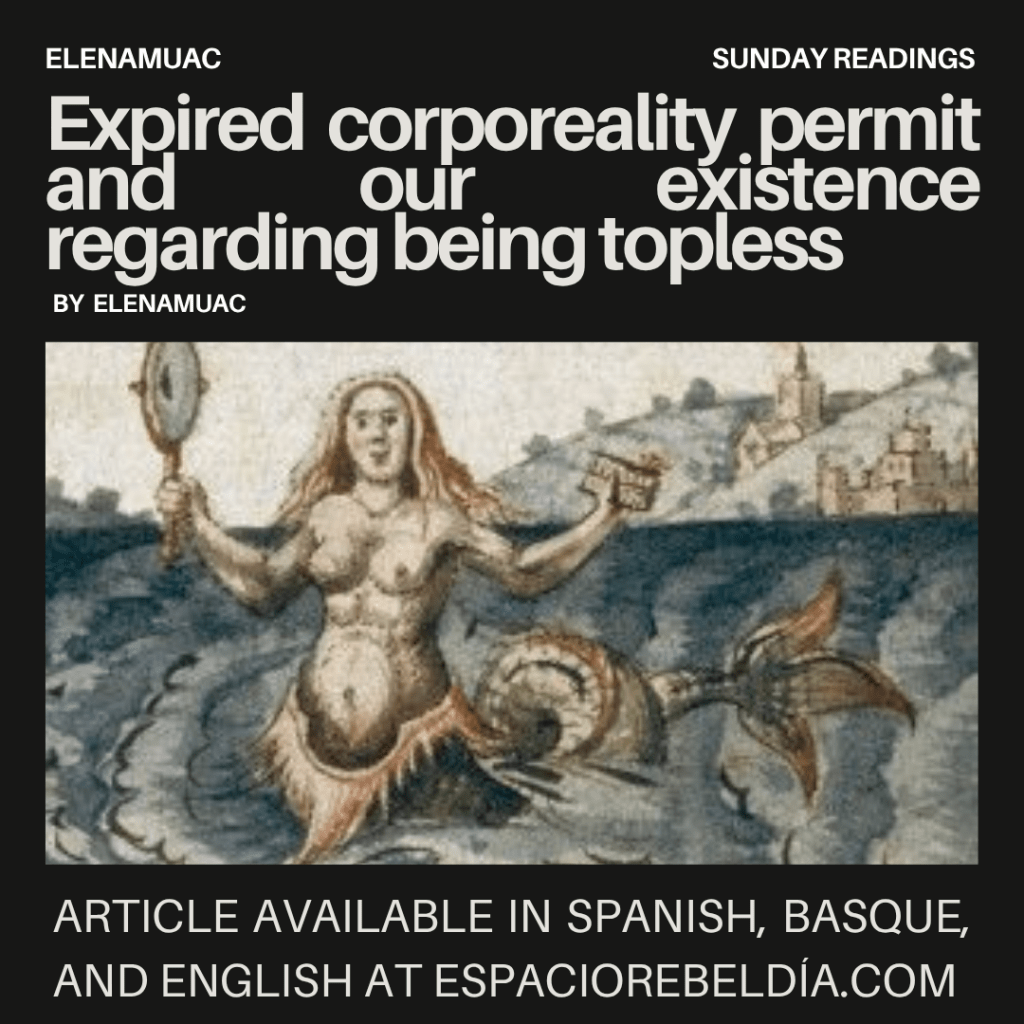
Expired corporeality permit and our existence regarding being topless
An opinion piece by elenamuac
Contact Elena by mail: elenaborrego2373l@gmail.com
Translation by @inkinthisorder and @batordenador
Our skin is the door to the world and our body is our passport to inhabit it. What happens when our corporeality permit expires? What happens when the male gaze police take so much space that they decide to deport bodies from the vital aesthetic panorama? How much is the bail we must pay so that our bodies can get out from the patriarchal mental jails? How many years are left on our sentence? What crime are we accused of?
It is incredible the number of questions that can pop in your mind while you extend your towel on the beach. You look at the vast sea and the tide brings in even more questions. Have you ever wondered when women started swimming in the sea? But more than women, their bodies. When were we allowed to live with our bodies in the margins of land? While talking about margins I visualise the limits of maps that separate continents from seas and that leads me to think that it is not a coincidence that the sea monsters in medieval maps had the shape of women. What can terrify men more than the bodies of women dwelling on the unknown, going where no man has ventured? Ironically, the first time they visualised us and, therefore, we exist in the water was alongside the demonisation of our bodies. Are we still trapped in the narrative of having to deform our bodies in order to pay the toll of external visual acceptance? Who decides which bodies occupy which spaces? Obtaining the corporeality permit is the longest public examination in history, but will that position ever be permanent? How could we pass if the syllabus always changes?
The question of who is making these exams is probably the only thing we know how to answer without hesitation. The patriarchy learned pretty early on that if we had property over our bodies, they would have little power over us, so they dedicated centuries to legislate over them. And they still do, using each time different strategies, taking advantage of any progress to slip into our minds. That is how we and our bodies arrive at the beach, skin vulnerable to any external attack, skin scanned a thousand times in front of different mirrors that imitate the sea surface where they intend to drown us. Each time, the summer self-confidence pack increases in price and we can afford it less, and the gaze of others is more and more piercing. Now we don’t even have to raise our heads to see it, we only have to turn on our phones and log into (their) social media.
Who advocates for us in the perpetual trial of aesthetics that we are subdued to? Is the Devil our advocate? It may as well be after centuries of linking our bodies to the diabolical, to sin and to temptation. Doesn’t temptation require and external actor to happen? Aren’t all those adjectives given to us without even asking? How can we perceive the female body without looking at it through the eyes of men when even our liberation has gone hand in hand with their freedom to desire us? We only have to take a look at the history of bathing suits in Spain to understand that even when we were promised bathing suits that would liberate our bodies, they were simply designed for the enjoyment of men. The campaigns of Hollywood actresses posing in bathing suits as if they were a price to win, where they showed more skin than what was usual at the time, were used as a visual incentive for men fighting in the Second World War.
I did not know that was what they meant when they said they were devoting themselves body and soul to the cause. Over which body was the battle happening?
With this chaos in my head you plunge into the sea and you contemplate: Is there a way to perceive our bodies without them? And also, going further, do our bodies exist when no one sees them? There is a linguistic theory proposed by philosophers of language in the 19th century that says, if a tree falls in the middle of the forest and no one is there to listen, did it really fall? That relates our existence directly with the capacity to perceive and be perceived. Do we only exist to be perceived?
I have spent half this article attempting to introduce the matter of being topless, but I always bump into the male gaze and I do not want them to articulate the definition of uncovering yourself. Being topless is the only moment when we are allowed to show our breasts without it being related to maternal or sexual reasons. If originally that female body was scandalous, now what is scandalous is the female body that does not serve male desire. As Rigoberta Bandini said with her famous “why are our tits so scary” (“por qué dan tanto miedo nuestras tetas”). The vindication of being topless is the vindication of the existence of our bodies without having anything to do with humanity or beauty. To enjoy nudity. Not think too much about showing our bodies. Do we become monsters when we uncover ourselves?
A crucial fact to continue reflecting on the social limits of exposing corporeality is the penalisation of being topless in Spain until 1989 for public indecency. The same country where liberalisation film was created did not allow their women to uncover themselves, ironic, isn’t it? Moreover, all the information about the history of women’s bathing suits has something to do with aesthetics, to the point where in many articles female nudity prevailed over the woman, meat over the body and the body over identity.
What’s personal is political, but one would want that going to the beach and swim topless wasn’t considered a political act nor indecent. Being able to take off the weight of fighting and swim peacefully, blending the limits of the body with the sea. Be it Mediterranean or Atlantic.
It is not the same being topless in Malaga or in Cadiz, it all depends on topography, but also on the angle of the gaze. The slope in Cadiz becomes the socket of the eye where it lays, it can only look if it falls, while in Malaga any gaze is perpendicular to the beach and, therefore, to the bodies that inhabit it. Where are the limits of being topless? More specifically, what are the limits of space permitted for it? Yes to being topless on beaches, on public swimming pools only in Catalonia. Being topless ends where the beach ends? Is the beach an oasis of civilisation? Yes on the beachfront, no on the street. Crossing bare-chested is prohibited. When you reach the asphalt civilisation begins, like the roman paths that indicated the limits of “barbarity”.
Bzzt, bzzt. Corporeality permit denied. Crossing the dream of civilisation without covering yourself is prohibited. Nude women in museums, tv shows, pornography, but never in real life. Not because they choose to. We came to the world asleep and nude, we woke up for the first time and then they covered us. Cover yourself! For God’s sake!
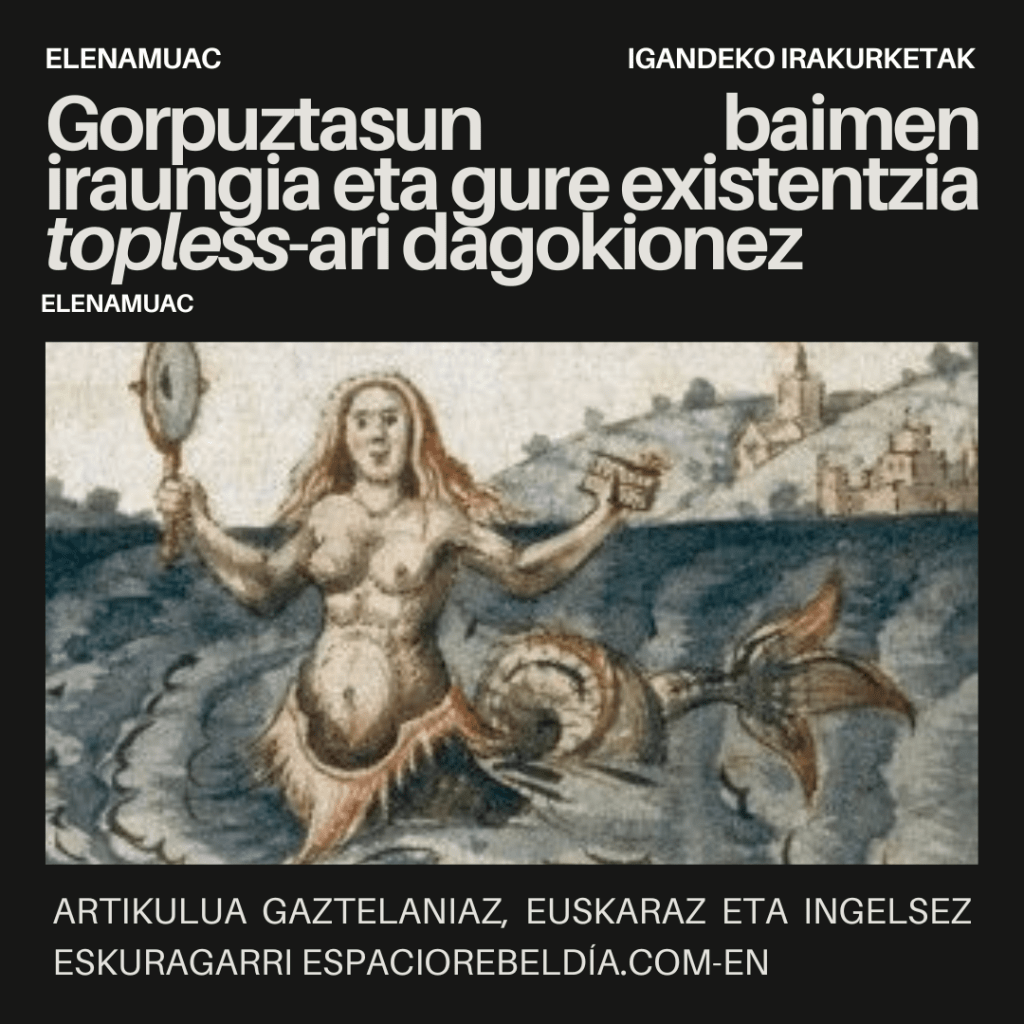
Gorpuztasun baimen iraungia eta gure existentzia topless-ari dagokionez
Elenamuac-en iritzi artikulua
Jarri harremanetan Elenarekin posta elektronikoz: elenaborrego2373l@gmail.com
Traducido por Udara Pascual. IG: @udarapascual
Gure azala mundurako atea da eta gure gorputza, bertan bizitzeko pasaportea. Zer gertatzen da gorpuztasun-baimena iraungitzen zaigunean? Zer gertatzen da begirada maskulinoaren patruila horrenbeste leku okupatzen duenean, non ezinbesteko panoramika estetikotik gorputzak deportatzea erabakitzen denean? Zenbateko fidantza ordaindu behar dugu gure gorputzak kartzela mental patriarkaletatik atera daitezen? Zenbat kondena falta zaigu betetzeko? Zein delituz gara egotziak?
Sinestezina da zenbat galdera etorri dakizkion pertsona bati edozein hondartzatan toalla zabaltzen duen bitartean. Eta batek itsasoaren hedadura begiratzen du eta itsasaldiak zalantza gehiago ekartzen ditu. Noizbait galdetu izan ahal duzue noiz hasi ziren emakumeak itsasoan bainatzen? Baina emakumeak baino gehiago, haien gorputzak. Noiz jaso genuen hauekin lurraren ertzetan bizi izan ahal izateko baimena? Ertzak aipatzerakoan, mapetan kontinenteak itsasotik banatzen dituzten limiteak irudikatzen ditut eta horrek, erdi aroko mapetan itsas munstroak emakume forma izatea kasualitatea ez dela pentsatzera eramaten nau. Zerk ikaratu dezake gehiago gizonak ezezagunean bizi den emakumeen gorputza baino, inongo gizonezko barneratu ez den horretara doazelarik? Ironikoki, irudikatu gintuzten lehen aldia, eta horrekin, uretako ingurumenean izan ginen lehen aldia, gure gorputzak deabrutu zituztenean izan zen. Besteen onarpen bisualaren bidesari gainditzea helburuz, gure gorputzak deformatzearen beharraren narratiban harrapatuta jarraitzen dugu? Nork erabakitzen du ze gorputzek hartzen dituzten espazioak? Gorpuztasunaren baimena lortzea historiako oposizio luzeenak dira, baina, noizbait ailegatzen da plaza finko bat lortzera? Nola gainditu gaitegia behin eta berriz aldatzen bada?
Seguruenik, azterketa hauek nork egiten dituen zalantzarik gabe erantzun dezakegun galdera bakarra da. Izan ere, patriarkatuak, gure gorputzen jabetza gurea eginez gero, gugan botere gutxi eragin zezakeela goizegi ikasi egin zuen, eta orduan, mendeetan zehar, hauetan eragiten zituzten legeak ezarri izan ditu. Eta oraindik jarraitzen du, geroz eta estrategia desberdin gehiago erabiliz, edozein aurrerapenez baliatuz, gure buru eta gogoetan sartzeko. Horrela iristen gara gu eta gure gorputzak hondartzetara, besteen erasoenenganako azal zaurgarria, ito nahi gaituzten itsaso horren azalera islatu egiten dituzten ispilu desberdinek milaka aldiz eskaneatu izan duten azala. Udako autoestimu pack-a geroz eta gehiago garestitu egiten da, eta zailago da lortzea, eta geroz eta gehiago kolpatzen gaituzte begiradek. Ez da burua altxatu behar hauekin topatzeko, gure mugikorrak irekitzearekin eta sareetan (haien) sartzearekin aski da.
Nor da betirako den epaiketa estetikoaren aurrean eramaten gaituen abokatua? Deabrua da gure abokatua? Horrela izan zitekeen mendeetan zehar gure gorputzak deabruari lotuak egon direlarik, bekatura lotuak eta tentaziori lotuak. Baina, ez du tentazioak beste jokalari bat behar gauzatua izateko? Ez dira ezarri zaizkigun izen adjektibo guztiak guri galdetu gabe ezarriak izan ote? Nola ulertu daiteke gorputz femeninoa gizonen begiak ez diren begiekin gure askatasuna haien desiraren askatasunarekin egokitua egon denean? Espainiako bainu jantzi femeninoen historia aztertzearekin aski da ulertzeko nola gure gorputzak askatuko zituzten jantziak hitzeman zizkigutenean, haiek soilik gozatzeko helburuz sortuak izan ziren. Are gehiago, sari bat izango balitz bezala, garai horretan ohikoa zen baino azal gehiago estali gabe uzten zituzten Hollywoodeko aktore femeninoen jantzien kanpainak, Bigarren Mundu Gerran borrokatzen zuten gizonezkoen sustapen bisualarentzako erabiliak izan ziren.
Ez nuen pentsatu horretaz ari zirela haien gorputza zerbitzuan jartzen ari zirela esaterakoan. Ze gorputzetan gauzatzen ari zen borroka?
Nahaspila horrekin buruan, norbera itsasoan murgiltzen da eta honakoa pentsatzen du: Existitzen da haiek egon gabe gure gorputzak hautemateko modurik? Gehiago esanda, inork ikusten ez dituztenean, existitu egiten dira gure gorputzak? XIX. mendean hizkuntzaren filosofoek eratutako hizkuntza-teoria bat dioenez: zuhaitza bat basoaren erdian erortzen bada, eta inork entzuten ez badu, egiatan erori al da? Honek, gure existentzia hautematearen gaitasunarekin eta hautemateak izatearekin zuzen erlazionatu egiten du. Emakumea, soilik hautematea izateko existitzen da?
Artikulu erdi daramatzat topless-aren gaia sartu nahian, baina begirada maskulinoarekin topatu egiten naiz beti, eta ez dut estalgabetzearen definizioa haiek ahoska dezaten nahi. Topless-a, sexuala dena edo amatiar denarekin lotuta egon gabe, bularrak erakusteko baimena dugun momentu bakarra da. Izan ere, hasiera batean, gorputz femeninoa zalaparta sortzen bazuen ere, orain, desira maskulinoa betetzen ez duen gorputz femeninoa da sortzen duena. Rigoberta Bandinik jada esan zuen bere “por qué dan tanto miedo nuestras tetas” esaldi famatuarekin. Topless-aren aldarrikapena, gure gorputzen existentziaren aldarrikapena da, hauek gizartea eta edertasuna bete behar izan gabe. Bakoitzaren biluztasunez disfrutatzea. Gorputza erakusterakoan, gehiegi ez pentsatzea. Munstro bilakatzen gara erakusten garelako?
Gorputza erakustearen limite sozialei buruz hausnartzen jarraitzeko beharrezkoa den datu garrantzitsua, Espainian, 1989. urtera arte zalaparta publikoagatik topless-a zigortzen zela da. Biluztasuna ugaria zen zinemetan arrakasta handia ematen zen bitartean, herrialde berean, emakumeak ez zuten estalgabetzeko baimenik, ironikoa ezta? Gainera, bainujantzi femeninoen historiaren inguruko informazio guztia estetikaren du zer ikusia, are gehiago, artikulu askotan, emakumearen biluztasunak emakume bera nagusitu egiten du, haragiak gorputza nagusitzen du, eta gorputzak identitatea.
Pertsonala dena politikoa da, baina norberak hondartzara joatea eta titietan bainatzea ekintza politiko zein lotsagarri bezala kontuan hartu ez izatea nahiko zukeen. Borrokaren pisua kentzea eta lasai bainatzea, gorputzaren eta itsasoaren arteko limiteak ezabatuz. Berdin dio mediterraneoa edo atlantikoa.
Ez da gauza bera Malagan edo Cádizen topless egitea. Topografiaren araberakoa da, baita begiraden angeluen araberako ere. Cádizen, limitea begiaren gaitasunak ezartzen du, soilik gerturatuz eta amilduz begira daiteke, Malagan, aldiz, edozein begirada hondartzarekiko perpendikularra da, eta beraz, bertan dauden gorputzenekiko perpendikularra. Non daude topless-aren limiteak? Zehatzago esanda, zeintzuk dira hau baimendutako tokien limiteak? Topless-a hondartzetan bai, igerileku komunitarioetan ez, soilik Katalunian. Topless-a hondartza bukatzen den lekuan bukatzen da? Hondartza zibilizazioaren oasia izanen da? Hondartzan bai, kalean ez. Debekatuta bular biluzik gurutzatzea. Kalearekin topatzerakoan hasten da zibilizazioa,”barbarie” limiteak adierazten zituzten erromatar bideak bezala.
Pi, pi, pi. Gorpuztasun baimen iraungia. Debekatuta herritartasunaren ametsa zeharkatzea estali gabe. Emakumeak biluzik museoetan, serietan, pornografian, baina inoiz ez errealitatean. Edo ez gutxienez haiek erabaki izanagatik. Mundura lo eta biluzik ailegatu ginen, lehen aldiz esnatu ginen eta orduan, estali gintuzten. Jainkoaren izenean, estali zaitez!
 ESPACIO REBELDIA
Deja un comentario