
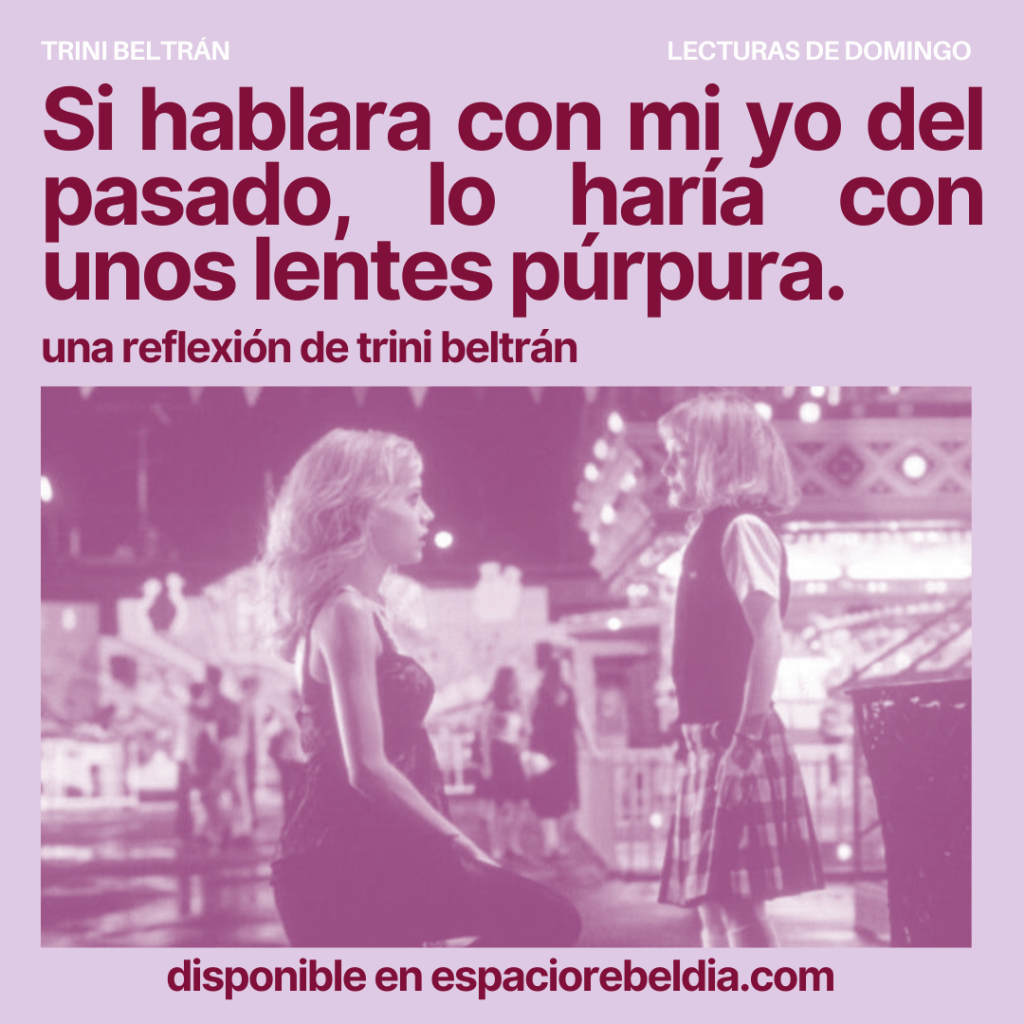
Si hablara con mi yo del pasado, lo haría con unos lentes púrpuras
Una reflexión de Trini Beltrán
Encuentra a Trini en Instagram y Tiktok:
¿Feminista? Me ha costado trabajo aceptarlo y abrazarlo, porque no sabía de dónde provenía la sensación de injusticia cuando yo pinté la fachada de la casa y la gente asumió que fue mi hermano, porque no identificaba el malestar que generó que mi suegro advirtiera a mi esposo que casarse con alguien que gana más dinero no era fácil o saber cómo reaccionar ante el coraje que siento cuando salgo de fiesta sola y escucho la frase “¿a poco te dieron permiso?”.
Transitar de forma individual los pequeños o grandes actos de violencia es un caso perdido. Se entiende menos de la mitad de las emociones y es sumamente difícil saber cómo reaccionar o qué decir. De donde yo vengo, llámese tiempo y espacio, nunca hubo una narrativa que enmarcara la validez de sentir que mi género no siempre actuaba a mi favor.
¿Qué habrá sido primero? ¿El cine, un libro, las redes sociales? No identifico el momento preciso en que mi vista comenzó a tornarse púrpura. Incluso hoy en día hay situaciones en las que me cuesta admitir en voz alta que me siento feminista.
Pero lo que haya sido simplemente me abrió los ojos al panorama de que no era la única, de que cada sensación tiene su nombre y de que mucho de lo vivido tuvo su grado de violencia, de ahí la incomodidad, el enojo y la sensación de injusticia.
Lo más difícil de tener conciencia social, de usar los lentes púrpuras, es lidiar con el propio pasado y con la propia violencia, ya sea ejercida por o hacia ti, porque es como separarse en dos y ver a tu yo del pasado con tristeza, queriendo aliviar su dolor como si se tratara de un tercero.
Hay una pregunta frecuente en charlas, juegos o clases: ¿a dónde irías si tuvieras una máquina del tiempo? A veces me imagino a mí misma entrando a un espejo para llegar a la habitación de mi yo del pasado y ver a esa chica de diecisiete años que pasó meses rezando todas las noches, pidiendo perdón por comenzar su vida sexual antes del matrimonio y, lo que era peor, disfrutar tanto. Todo esto mientras mi madre advertía a mi hermano menor que era mejor siempre llevar preservativos.
Tenía un cirio que encendía todas las noches, un rosario y un librito con las letanías que al final ya me sabía de memoria. A veces pedía fuerza para dejar de hacerlo, pero la mayoría de las noches era más como una compensación porque me quedaba claro que no iba a parar, entonces los rezos eran un tributo para pecar sin ir al infierno.
Si en realidad pudiera visitarla, le diría: “No pierdas el tiempo sintiendo una culpa que no proviene de ti, disfruta”.
Desde la pandemia no voy a la iglesia, la fotografía de mi primera comunión sigue colgada en la sala y los parientes preguntan por qué mis hijos no van al catecismo. La prudencia y la educación tienen su límite, que se rompe cuando exigen respeto por sus creencias pero no respetan las tuyas, así que las respuestas sutiles van siendo reemplazadas con comentarios reales que hieren susceptibilidades.
No pienso perpetuar tradiciones que sometan a mis hijos a sentimientos de culpa y represión que controlan hasta tus pensamientos y tu intimidad.
Me costó muchos años, películas y lecturas poder desbloquear un recuerdo que en su momento solo catalogué de incómodo y hoy creo que es de los más violentos que tengo.
En la creencia religiosa que profesaba existe esta manera de vaciarte de tus pecados contándoselos a un extraño con la capacidad de absolver tu culpa. Aunque nadie me obligaba a hacerlo, si no estabas limpia entonces no podías formarte a comulgar, y si no lo hacías todo mundo sabía que habías pecado. Un escrutinio discreto de pensamiento, palabra, obra y omisión.
Elegía categóricamente las palabras de mi lista. Eran técnicas, sin descripciones, no había charla como en terapia y menos si hay una fila de ocho pecadores más esperando su turno. Si lo hacía en un templo viejo, tenía la ventaja del anonimato con esas estructuras de madera donde te arrodillas detrás de una reja cubierta por una tela roja que no permite ver claramente a tu confesor.
Acababa de cumplir diecinueve años, era un evento con cientos de jóvenes en un espacio amplio. Pusieron las sillas de varios confesores en un jardín, respetando cierta distancia entre una y otra para resguardar la privacidad.
Él tendría más de cincuenta años, ataviado de blanco y con esa tela especial alrededor del cuello. Nos sentamos para vernos frente a frente y comencé con mi lista de verbos. No me interrumpió cuando mencioné mentir o desobedecer a mis padres, sino al mencionar los actos impuros; esas eran las palabras clave que usaba para sanar mi culpa por ser sexualmente activa. Eran ambiguas, pero dentro de la jerga regularmente eso era suficiente. Pero no para este hombre: ¿tienes relaciones?, ¿con quién?, ¿ves pornografía?, ¿de qué tipo?, ¿te masturbas?…
Me levanté de esa silla de plástico y no sentí el alma ni blanca ni limpia, pero ese acto de humildad al vaciar mi intimidad ante un extraño era la prueba de que yo quería ser buena.
No hay manera de volver atrás, pero desde entonces he hablado muchas veces con esta chica y estamos en paz.
El feminismo está ahí de manera general porque el mundo lo necesita, pero también porque de forma individual sana y ayuda a reclamar la libertad que merecemos, da el empuje que nos hace falta para hacer los cambios que necesitamos, reflexionar si estamos viviendo como se supone que o como realmente queremos y, si he de dejar una herencia filosófica para las futuras generaciones, no será una que reprima y amenace, sino que enaltezca la rebeldía, valore la naturaleza humana y no promueva una conciencia social fingida.
Escrito mientras escuchaba a Sofía Isella
If I could talk to my past self, I would do so wearing purple glasses
A reflection by Trini Beltrán
Find Trini on Instagram and Tiktok:

Feminist? It has been difficult for me to accept and embrace this label, because I didn’t know where the feeling of injustice came from when I painted the front of the house and people assumed my brother did it; because I couldn’t identify the discomfort caused by my father-in-law warning my husband that marrying someone who earns more money wasn’t easy; because I don’t know how to react to the anger I feel when I go out partying alone and hear the phrase, ‘Did they give you permission?’
Going through small or large acts of violence individually is a lost cause. Less than half of the emotions are understood, and it is extremely difficult to know how to react or what to say. Where I come from, named time and space, there was never a narrative that framed the validity of feeling that my gender did not always work in my favour.
What came first? The cinema, a book, social media? I cannot pinpoint the exact moment when my vision began to turn purple. Even today, there are situations in which I find it difficult to admit out loud that I feel like a feminist.
But whatever it was, it simply opened my eyes to the fact that I was not the only one, that every feeling has a name and that much of what I experienced had a degree of violence, hence the discomfort, anger and sense of injustice.
The hardest part of being socially conscious, of wearing purple glasses, is dealing with your own past and your own violence, whether it was perpetrated by you or against you, because it’s like splitting yourself in two and looking at your past self with sadness, wanting to ease their pain as if they were someone else.
There is a frequent question in talks, games or classes: where would you go if you had a time machine? Sometimes I imagine myself stepping into a mirror to reach my past self’s room and see that seventeen-year-old girl who spent months praying every night, asking for forgiveness for starting her sex life before marriage and, what was worse, enjoying it so much. All of this while my mother warned my younger brother that it was always best to carry condoms.
I had a candle that I lit every night, a rosary and a little book with litanies that I eventually knew by heart. Sometimes I asked for the strength to stop doing it, but most nights it was more like compensation because it was clear to me that I wasn’t going to stop, so the prayers were a tribute for sinning without going to hell.
If I could actually visit her, I would say: ‘Don’t waste your time feeling guilt that doesn’t come from you, enjoy yourself.’
I haven’t been to church since the pandemic, the photograph of my first communion is still hanging in the living room, and relatives ask why my children don’t go to catechism. Prudence and politeness have their limits, which are broken when they demand respect for their beliefs but do not respect yours, so subtle answers keep being replaced with real comments that hurt sensibilities.
I do not intend to perpetuate traditions that subject my children to feelings of guilt and repression that control even your thoughts and your privacy.
It took me many years, films and books to unlock a memory that at the time I simply classified as uncomfortable, but today I believe is one of the most violent I have.
In the religious belief I professed, there is this way of emptying yourself of your sins by telling them to a stranger with the ability to absolve your guilt. Although no one forced me to do it, if you weren’t clean, then you couldn’t be trained to take communion, and if you didn’t do it, everyone knew you had sinned. A discreet scrutiny of thought, word, deed, and omission.
I chose the words on my list carefully. They were technical, without descriptions, there was no chit-chat like in therapy, and even less so when there was a line of eight other sinners waiting their turn. If I did it in an old temple, I had the advantage of anonymity with those wooden structures where you kneel behind a grille covered by a red cloth that prevents you from seeing your confessor clearly.
I had just turned nineteen, and it was an event with hundreds of young people in a large space. They set up chairs for several confessors in a garden, keeping a certain distance between them to ensure privacy.
He was over fifty years old, dressed in white and wearing that special cloth around his neck. We sat down to face each other, and I began with my list of verbs. He didn’t interrupt me when I mentioned lying or disobeying my parents, but when I mentioned impure acts; those were the keywords I used to heal my guilt for being sexually active. They were ambiguous, but in slang, that was usually enough. But not for this man: do you have sex? With whom? Do you watch pornography? What kind of? Do you masturbate? …
I got up from that plastic chair and didn’t feel my soul white or clean, but that act of humility in emptying my intimacy before a stranger was proof that I wanted to be good.
There’s no going back, but since then I’ve talked to this girl many times and we’re at peace.
Feminism is there in general because the world needs it, but also because, individually, it heals and helps us reclaim the freedom we deserve. It gives us the push we need to make the changes we require, to reflect on whether we are living as we are supposed to or as we really want to. And if I am to leave a philosophical legacy for future generations, it will not be one that represses and threatens, but one that exalts rebellion, values human nature, and doesn’t promote a feigned social conscience.
Written while listening to Sofía Isella
 ESPACIO REBELDIA
Deja un comentario