
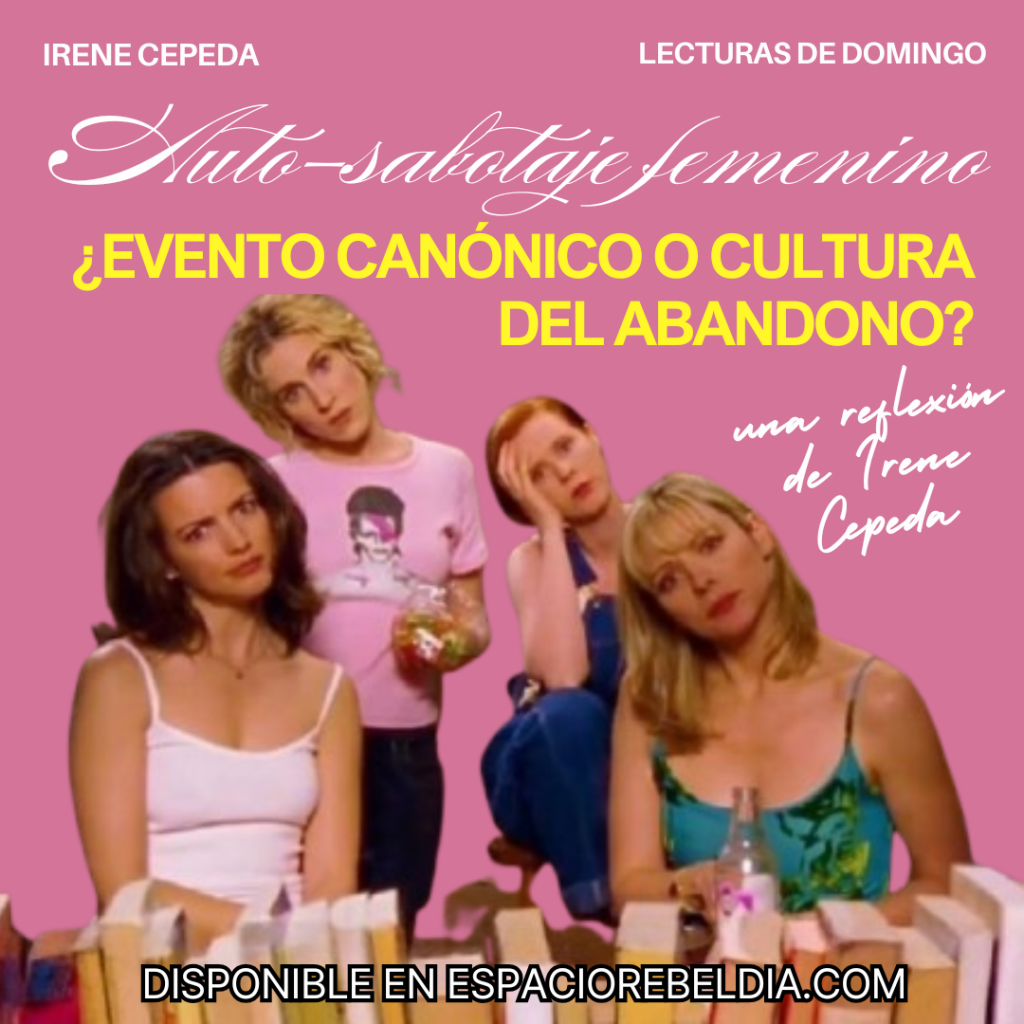
Autosabotaje femenino
¿Evento canónico o cultura del abandono?
Una reflexión de Irene Cepeda
Encuentra a Irene en Instagram:
A mi amiga Lucia,
que mientras yo escupía todo esto,
al borde del llanto,
ella a mi lado asentía
mientras se liaba el cigarro.
Ahí entendí que habríamos necesitado
un banco más grande para todas.
Es curioso cómo se mueve la costumbre en el sexo femenino, cómo se intercambia la información de la cotidianidad. Un día estás sola en la sala de espera del médico, muerta de miedo, pensando que quizá las molestias en tu entrepierna son fruto de una terrible enfermedad venérea —cuando es prácticamente imposible, pues nunca has mantenido relaciones— que provendría de aquella tarde en la que te pasaste dos horas besándote con Gonzalo en el parque de al lado del instituto. “La saliva tendrá algo que ver”, piensas fugazmente desde el desconocimiento, mientras las palabras “eres una guarra, te lo mereces” retumban en tu cabeza, entre paciente que sale y paciente que entra de aquel lúgubre lugar.
La sentencia es rápida y directa: “No te pasa nada, los picores son normales, el pH y la flora vaginal es algo que se puede alterar con la toma de antibióticos, cambios hormonales…”, repite con cansancio la doctora. Seguramente no eres la primera chica de quince años que viene con el mismo diagnóstico, ni vas a ser la última. ¿Por qué entonces nadie me ha dicho nada de esto? Qué frustración. Sientes que la pelota va de un lado a otro sin llegar a ti, nadie habla de las cosas importantes. Pero el mensaje que se te quedará grabado después de esta visita médica es claro: “Todo lo malo que te pase, en realidad, te lo mereces.”
Y este mantra autodestructivo te acompañará hasta el fin de tus días. Siento no poder darte un mensaje más optimista que este, pero al menos te adelanto que la información sobre molestias genitales, métodos anticonceptivos, prevención de enfermedades y capullos narcisistas será mucho más accesible y fluida. No porque te lo vayan a explicar: es porque comenzarás a hablar. Bueno, más bien, comenzaremos a hablar entre nosotras. Un día verás que tu amiga María tiene la misma cara que pusiste tú el día que fuiste sola al centro de salud, y le preguntarás y compartirás la información. Y ella lo hará contigo sobre otras cosas que desconoces. Y así es como, de repente, los vestuarios y los baños se vuelven un lugar único de sabiduría y diálogo. Por fin te llega la pelota, y no para de moverse. Si Platón hubiera montado su academia entre los muros de un vestuario femenino, estoy segura de que ya en la época de los estoicos se habría llegado al idealismo del que habla Kant. Pero nunca han escuchado.
Cuando era niña, recuerdo cómo mi padre solía reprocharle a mi madre lo mucho que “se enrollaba” hablando cada vez que se encontraba con una amiga. Hoy en día no pasa una semana sin que escuche algún comentario de un hombre sobre lo mucho que hablamos o lo “cotillas” que somos las mujeres cuando nos juntamos.
Pero hablamos entre nosotras porque nadie más nos cuenta. La cotidianidad femenina pasa por debajo de nuestros pies, por debajo de las raíces de los árboles y por debajo de la línea 6 del metro. Pero no es fácil comenzar a hablar cuando te han enseñado a callar. No aparecen en la televisión, ni se enseñan en la escuela, ni lo encontramos en los libros. Y nuestras madres, muchas veces, tampoco nos lo dicen… quizá porque ellas tampoco lo saben.
Y así vas creciendo, sintiendo que cojeas de un pie. La información que te rodea es de un mundo al que no perteneces. Grandes héroes aventureros que pelean con espadas y ninguno tiene tetas. Empresarios voraces y guapos que triunfan en las películas manejando un yate mientras una rubia bebe champán. Escritores narcisistas y mediocres que se creen poseedores de la verdad. Estás agotada y sola. Un máster, una carrera, tres idiomas, innumerables citas… Todo ello te sabe a poco. Sientes la insatisfacción clavada en el costado justo antes de irte a dormir y te cuesta respirar.
¿Por qué? Podrías crear una lista, y perfectamente habrías conseguido muchas de las cosas que deseabas con apenas trece años. Tienes mucho más currículum que cualquiera de tus compañeros. Pero, aun así, después de cada examen, de cada proyecto, sales mordiéndote el labio. No corre la más mínima brisa de satisfacción. Siempre te suicidas al llegar.
Pasaste media juventud leyendo ensayos de mujeres. Te levantaste optimista de la cama al leer a Beauvoir, lloraste de placer al sentir que Sylvia Plath te comprendía, e incluso te pusiste cachonda con algunos libros de Almudena Grandes. En la universidad has tenido grandes profesoras. Todas fuman mucho, las ves en congresos que se emiten por YouTube y piensas que tú también te quieres dejar canas, que no caerás en esos tintes agresivos que borran el paso del tiempo.
Apenas tienes veintiséis años, y caes. Caes cuando pronuncias a tu amiga las palabras prohibidas para tu moral: “Tengo tanto miedo de acabar sola, Lucía”. El público se estremece, caras de asco y pánico. Una niña comienza a llorar, Simone de Beauvoir se ha ido de la sala y Sylvia Plath ha encendido el horno. No puede más con tu cinismo. Y tú, tampoco. ¿Será posible que, después de todo, TODO (interminables horas en la biblioteca de tu facultad, asambleas temáticas sobre la deconstrucción del género y el patriarcado, dolores de cabeza intentando entender a Hegel y algún que otro lío poliamoroso), descubras que te produce un pavor inhumano verte sola a tus 40 años? Y que, si la cagas y acabas sola, es porque te lo mereces. La culpa cae a plomo, está pegada en cada poro de tu piel. Otra vez te sientes como en la sala de espera del centro de salud, aunque ahora no te pica la entrepierna, y solo lloras. ¿Qué pensaría mi yo de 13 años al verme llorando y sin disfrutar de mi vida porque no tengo una pareja? Pensaría que soy una mujer cliché más, que solo quiere recibir a su marido cuando llega de trabajar. Pero sientes que hay algo más complicado que eso.
Y ahí es cuando te giras y ves que tu amiga está con las lágrimas a punto de desbordar, y que asiente con la cabeza, mientras ya casi se está fumando el filtro de su cigarrillo que ha consumido a bocanadas durante tu discurso. De nuevo: ¿por qué nadie me ha dicho que no era la única que se sentía así? Otra vez sientes que la pelota pasa de un lado a otro sin llegar a ti, pero ya no están los vestuarios del instituto. Un hilo de Twitter es lo más parecido que tienes a esa especie de comunidad que recordabas. Os miráis, suspiráis y reís amargamente. Y os hacéis la pregunta que os lleváis haciendo desde hace años: ¿se sentirán así los hombres?
Por supuesto que no. Además, tu crisis va a colisionar con la crisis que suele sentir el joven promedio en la mitad de su veintena, y es la de sentirse libre y “vivir la vida”. La que los lleva a romper su relación de cinco años, de la forma más imprevisible posible, y empezar a frecuentar discotecas y afters.
Ellos, con menos currículum que tú, menos alcance, menos idiomas y sin entender a Hegel, han conseguido lo mismo que tú. Pero la gran diferencia es que ellos sí encuentran satisfacción en lo que hacen. Ellos sí se reconocen en esos héroes de las películas, en ese empresario rico y en ese escritor narcisista. Hasta los 12 años, o quizá más, la mayoría de nosotras no hemos tenido referentes. Identificaste las cualidades con las que se reconocía al sexo femenino como una debilidad, como unas “cotillas”. Tu primer ejemplo de mujer soltera independiente fue la vieja de los gatos en Los Simpson, y aunque adores a Pizarnik, las primeras novelas que leíste, por mucho que te joda, son de Pérez-Reverte.
Te autosaboteabas porque, por mucho que insistieras, sentías que ese no era tu lugar, no hay lugar para ti, no hay nadie como tú que sea protagonista de esos logros, y encima tampoco eres la rubia que bebe champán en el yate con el millonario. Según la psicología actual, la personalidad se forma hasta los 7 años y los primeros 10 son fundamentales para el aprendizaje. Es normal que tengas arraigado ese miedo, es difícil deshacerse de él, e incluso de alguna manera es ancestral. Siempre el ser humano ha tenido miedo de la soledad, pero hay que analizar con perspectiva de género cuando estos miedos pesan más en la balanza de las mujeres que en la de los hombres.
Female self-sabotage
Canon event or abandonment culture?
A reflection by Irene Cepeda
Find Irene on Instagram:

To my friend Lucía, who nodded
and rolled a cigarette while I was
spitting/spewing all this at the verge of tears,
by my side.
That’s where I understood that we would
have need a bigger bench for both of us.
It is curious how tradition moves in the female sex, how the information of the ordinary is exchanged. One day you are alone on the doctor’s waiting room, scared to death, thinking that maybe the discomfort on your groin is the product of a terrible venereal disease —when it is practically impossible, as you have never had sexual relations— that you caught on that afternoon when you spent two hours kissing Gonzalo on the park just by your high school. “Spit must have something to do with it”, you think fleetingly in your ignorance, while the words “you are a slut, you deserve it” echo in your head between patients that enter and leave that dreadful place.
The doctor’s verdict is fast and direct: “You are fine, the itching is normal, the pH of your body and your vaginal microbiota can be altered by the intake of antibiotics, hormonal changes…”, she drones on. Surely you are not the first fifteen-year-old girl that comes with the same diagnosis, and you will not be the last. Why, then, has no one told me about it? So frustrating. You feel like the ball is going from one side of the field to the other without reaching you, no one talks about the important things. But the message that will mark you after this doctor’s visit is clear: “Everything bad that happens to you, in fact, you deserve it”.
And this self-destructive mantra will accompany you to the end of your days. I am sorry that I cannot give a more positive message than this one, at least I will tell you in advance that information about genital discomfort, contraceptive methods, disease prevention and narcissist assholes will be a lot more accessible and free-flowing. Not because anyone is going to explain it to you: it is because you will start talking. Well, more like we will start talking with each other. One day you will see your friend María with the same face you had the day you went alone to the doctor, and you will ask her about it and share information. And she will share things with you that you did not know about. And that is how, suddenly, locker rooms and toilets become a unique place for wisdom and dialogue. Finally, the ball reaches you, and it does not stop moving. If Plato had built his academy between the wall of a female locker room, I am sure that they would have reached Kant’s idealism by the time of the stoics. But they have never listened.
When I was a child, I remember how my father used to reproach my mother how she “prattled” with her friend every time she saw her. Nowadays, a week doesn’t go by without hearing comments from men about how women talk too much or how much we “gossip” when we get together.
But we talk with each other because no one cares about us. Female day-to-day experience goes unnoticed, under the roots of trees and under Madrid’s sixth tube line. But it’s not easy beginning to talk when you’ve been taught to be silent. It doesn’t appear on TV, nor taught in school, nor can be found in books. And our mothers, a lot of times, don’t tell us either… maybe because they don’t know either.
And so you grow, feeling like you are limping. The information around you comes from a world you don’t belong to. So many great adventurous heroes that fight with swords and none of them have tits. Voracious and handsome businessmen that succeed in films, driving a yacht while some blondie drinks champagne. Narcissist and mediocre writers that believe they hold the truth of life. You are exhausted and alone. A master’s degree, a university degree, three languages, countless quotes… It all doesn’t feel enough. You feel dissatisfaction like a thorn in the flesh every time you go to sleep and you struggle breathing.
Why? You could make a list, and you’d have achieved many of the objectives you set at thirteen. Your curriculum is bigger than any of your peers’. Even so, after every exam, every project, you leave biting your lip. Not even a breeze of satisfaction. You always kill yourself at the end.
You spent half your youth reading women’s essays. You woke up with optimism after reading Beauvoir, you cried in relief after seeing that Sylvia Plath understood you and even got horny reading some Almudena Grandes’ books. You’ve had great female professors at university. They all smoke a lot, you see them at conferences streamed on YouTube and you think that you also want to let your hair go grey, that you won’t fall for those aggressive dyes that erase the passage of time.
You’re barely twenty-six years old, and you fall for it. You fall when you tell your friend the forbidden words for your morals: “I’m so scared of ending up alone, Lucía”. The public shudders, with faces of panic and disgust. A little girl starts crying, Simone de Beauvoir has left the room and Sylvia Plath has turned the oven on. She can’t stand your cynicism. And neither can you. Is it possible that after everything, EVERYTHING (endless hours at your university’s library, theme-based assemblies about the deconstruction of gender and the patriarchy, the headaches trying to understand Hegel and the occasional polyamorous hookup), you realise that you are terrified of being alone at forty? And that, if you screw up and end up alone, it’s because you deserve it. The guilt falls heavy, stuck to every pore of your skin. You start feeling again like on the doctor’s waiting room, except now your groin doesn’t itch, you are just crying. What would my thirteen-year-old self think, seeing me cry and not enjoying my life just because I don’t have a partner? She’d think that I’m just another cliché woman, that wants only to welcome her husband when he comes back from work. But you feel like there’s something more complicated than that.
And that’s when you turn around and see that your friend’s tears are about to fall, and that she’s nodding along, almost smoking the filter of her cigarette already, having consumed it over your speech. Again: why did no one tell me that I wasn’t the only one feeling this way? You feel once again that the ball goes from one side of the field to the other without reaching you, but the high school locker room is no more. A Twitter thread is the closest thing you have to the type of community that you remember. You look at each other, sigh and laugh bitterly. And you ask yourselves the question that you’ve been asking for years: do men feel this way?
Of course not. Besides, your crisis collides with the crisis the average young man usually experiences in his mid-twenties, where he feels free and “lives his life”. The one that leads them to break up their five-year relationships, in the most unpredictable way, and start frequenting clubs and afters.
They, with a smaller curriculum than you, less reach, fewer languages and not understanding Hegel, have achieved the same as you. But the big difference is that they do find satisfaction in what they do. They do recognise themselves in those heroes of the films, in that rich businessman and in that narcissistic writer. Until we were twelve, or maybe after, the majority of us haven’t had any role models. You identified the qualities that described the female gender as weak, as “gossips”. Your first example of a single woman was the Crazy Cat Lady from The Simpsons, and even though you adore Pizarnik, the first novels you read, though it pains you, were by Pérez-Reverte.
You sabotage yourself because, as much as you insisted, you felt that that wasn’t your place, there is no place for you, there is no one like you that is the protagonist of those achievements, and to top it all off you are not the blondie that drinks champagne on the yacht of a millionaire. According to modern psychology, your personality is forming until you are 7 years old, and the first 10 years of your life are essential for learning. It’s normal that that fear is rooted inside you, it’s difficult to get rid of it, it’s ancestral even, in some way. The human has always been afraid of being alone, but we must analyse from a gender perspective when these fears weigh more on the scale of women than on the men’s.
 ESPACIO REBELDIA
Deja un comentario