
ENTRE AMAR Y SER AMADA
Una reflexión de Lucía García
Encuentra a Lucía en X:

A veces siento que el amor que siento es tan grande que abruma. No solo al resto, sino a mí misma. Me devora desde dentro, me fragmenta. Y en ese desbordamiento, descubro que el amor, para las mujeres, no es una elección. Es una imposición envuelta en terciopelo.
Jamás he visto a un hombre amar por encima de su moral. Para ellos, el amor es un complemento, una posibilidad entre muchas. Para nosotras, en cambio, es el todo. Desde pequeñas se nos educa para anhelarlo, buscarlo, sufrir por él. Incluso cuando tratamos de huir, nos alcanza. El amor se adhiere a nuestra piel como una segunda identidad: si no amamos, no somos completas.
Un hombre puede permitirse no amar nunca —por defecto, amar a muchos— y sentirse pleno, incluso moralmente superior a aquellos que se entregan. Puede amar y luego dejar de hacerlo sin culpa, sin juicio. Puede no necesitar el amor para construirse. Puede vivir sin mirar atrás.
Para una mujer, el amor implica sacrificio. Una mujer deja de existir para amar. No amar se vive como una mutilación íntima. Amar supone renunciar: a los sueños, a los valores, a los vínculos propios. El amor se le presenta como una divinidad a la que hay que venerar en cuerpo y alma sin elección alguna. No importa a quién se ame, mientras se ame. El objeto del amor se vuelve secundario; lo esencial es que esa llama permanezca encendida.
Mientras el hombre ama sin perderse, la mujer ama hasta dejar de existir. Para él, el amor es un lugar cómodo, una prolongación del cuidado materno. Una relación en la que siempre gana: recibe comprensión, refugio, ternura. Para ella, el amor es darlo todo sin esperar reciprocidad. Su recompensa es ser mirada, como se mira a una joya: valiosa, sí, pero muda, fija, inmóvil. Lo que la mujer anhela, al final, no es solo ser amada, sino ser vista. No como sujeto, sino como objeto deseado, admirado, necesitado.
Pero algo ha cambiado. Quizás por suerte, quizás por castigo, la mujer comienza a deshacerse de esa necesidad de ser mirada. Ya no ama por instinto ni por mandato. Ama porque elige hacerlo. Y al hacerlo, exige. Decide. Compara. En ese acto de libertad, descubre una verdad amarga: su capacidad de amar no es correspondida. Su don se convierte en su condena.
La caída del amor como ideal absoluto es una caída del mito. El amor deja de ser dios. Amar ya no es un don divino sino una acción más, banal, cotidiana. Y esa desacralización deja un vacío. ¿Qué hacer con la inmensidad del deseo cuando ya no hay altar donde depositarlo?
En esa desolación aparece nuestro mayor enemigo: la ficción. La novela romántica, escrita por mujeres para mujeres, actúa como un salvavidas emocional. En sus páginas, los hombres aprenden a amar como ellas desean, aunque solo en papel. Allí existen hombres que escuchan, que lloran, que esperan. Hombres capaces de sentir con la intensidad femenina. Pero esos hombres no existen. Son espejismos que alimentan una esperanza enferma: la de que algún día, alguien amará como tú.
Y, sin embargo, esa esperanza es necesaria. Porque aceptar que no te aman como tú amas es desolador.
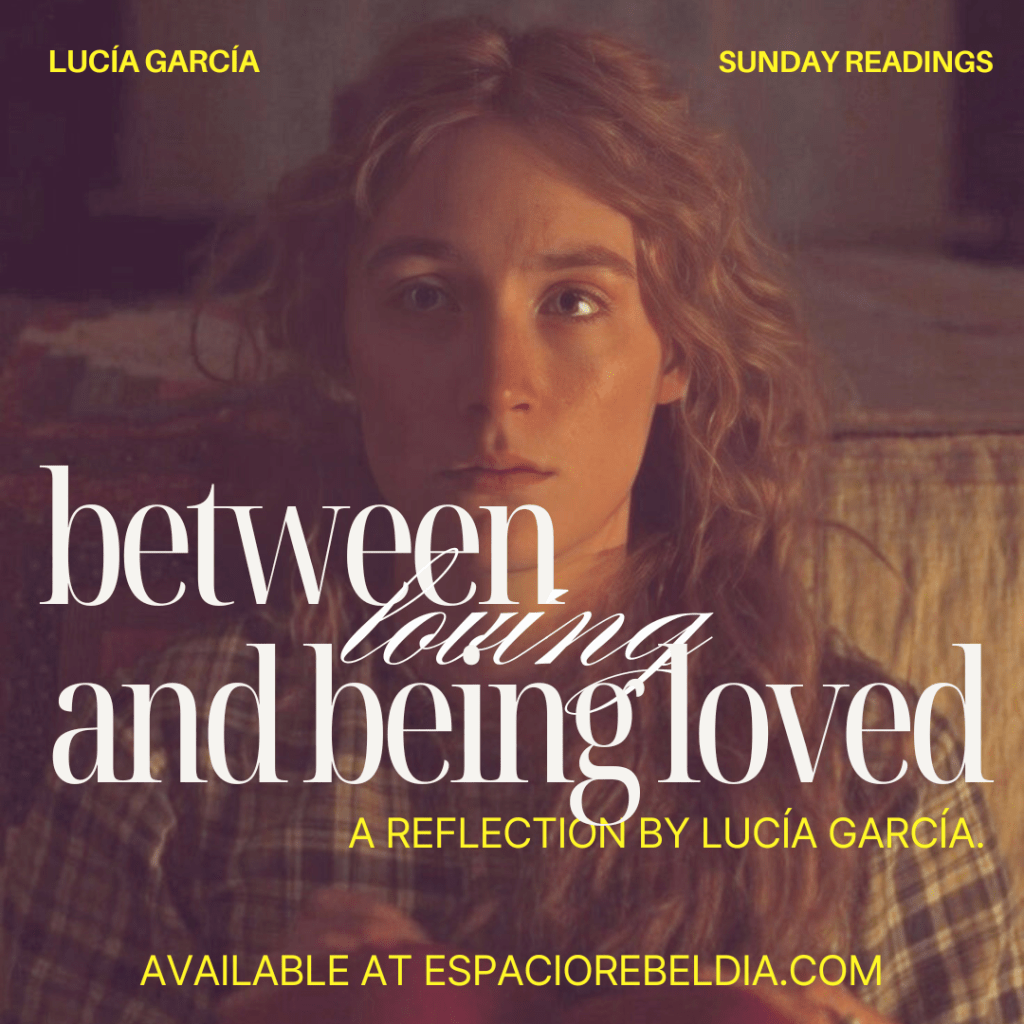
BETWEEN LOVING AND BEING LOVED
A reflection by Lucía García
Find Lucía on X:
Sometimes I feel that the love I feel is so big that it overwhelms. Not only other people, but myself. It consumes me from within, it fractures me. And with that overflowing I discover that love, for women, is not a choice. It is an imposition wrapped in velvet.
I have never seen a man love over his own morality. For them, love is an accessory, a possibility between many. Whereas for us, it is everything. From childhood we are taught to yearn for it, to look for it, to suffer for it. Even when we try to run from it, it reaches us. Love attaches to our skin like a second identity: if we do not love, we are not complete.
A man can afford to never love —by default, love many— and feel whole., even morally superior to those who give themselves to it. They can love and then stop without guilt, without judgment. They do not need love to build themselves. They can live on without looking back.
For a woman, love means sacrifice. A woman stops existing to love. Not loving feels like an intimate mutilation. Love entails giving up: dreams, principles, personal bonds. Love is presented to women as a divinity they must worship in body and soul with no choice at all. Who you love does not matter, as long as you love. The object of affection becomes secondary; keeping that flame lit is what is essential.
While men love without losing themselves, women love until they cease to exist. For him, love is a comfortable place, an extension of motherly care. A relationship in which he always wins: he receives understanding, shelter, affection. For her, love means giving everything without expecting reciprocity. Her reward is being looked at, like you look at jewellery: valuable, yes, but silent, still, immobile. What women yearn for, at the end, is not only being loved, but being seen. Not as an individual, but as a desirable object, admired, needed.
But something has changed. Maybe by luck, maybe as punishment, women are starting to get rid of the necessity to be looked at. They do not love by instinct or by command anymore. They love because they choose to do so. And by doing so, they demand. They decide. They compare. In this act of freedom, they discover a bitter truth: their capacity to love is not reciprocated. Their gift becomes their sentence.
The fall of love as an absolute ideal is the fall of a myth. Love stops being a god. Love is no longer a gift from heaven but another action, trivial and ordinary. Love is secularized, and it leaves a hole. What is to do with the immensity of desire when you no longer have an altar to place it?
Before this desolation our biggest enemy appears: fiction. Romance novels, written by women for women, they work as emotional lifelines. Among their pages, men learn to love as they wish, although only in paper. There exist men that listen, that cry, that wait. Men capable of feeling with a female intensity. But those men do not exist. They are illusions that feed an unhealthy hope: that someone someday will love like you.Nevertheless, that hope is necessary. Because accepting that no one loves you like you do is heartbreaking.

 ESPACIO REBELDIA
Deja un comentario