
EL JARDÍN DE LOS PÁJAROS TRANSPARENTES: UNA FÁBULA SOBRE LOS LÍMITES INVISIBLES
Un texto de Estíbaliz Becerro
Encuentra a Estíbaliz en Instagram:

Mi infancia transcurrió entre las flores del jardín que mi abuela cuidaba con tanta cautela. En él, no quedaba ni una flor sin recibir la atención merecida: claveles, rosas, petunias, etc. El jardín que me tocó cuidar a mí difiere mucho del protagonista de un verano melancólico de la primera década del siglo XXI. Hay jardines, como el mío, que no crecen en la tierra, sino en la imaginación colectiva. Jardines elevados, que flotan en lo alto, sostenidos por la tradición, la costumbre, el miedo. Uno de ellos, invisible desde abajo, está habitado por los Pájaros Transparentes.
Estos pájaros —más idea que animal— nacen con alas hechas de deseo, pensamiento y memoria. Su transparencia no es un defecto, sino un reflejo del lugar que ocupan: han aprendido a no hacerse notar, a volar sin alborotar el viento, a cantar en tonos que no molesten. Desde pequeñas, se les enseña que su vuelo es libre, pero con una libertad administrada. Que pueden alcanzar el cielo, siempre que no pregunten de qué está hecho.
Y, sin embargo, sobre ese jardín pende un techo. Un cielo de cristal. Invisible a simple vista, pero implacablemente presente. No lo cubre todo: permite ver las estrellas, soñar con el azul, imaginar que el aire es infinito. Pero está ahí. Y cuando alguna pájara alza el vuelo con fuerza y ambición, lo descubre de la manera más cruel: con el golpe seco de lo que no se nombra, con la frustración de lo que no se ve, pero sí se siente.
Este techo de cristal no es una simple metáfora. Es la traducción estructural de la desigualdad. Es la manera en que el mundo laboral, académico, político y social —diseñado históricamente por y para hombres— sigue frenando el ascenso de quienes no se ajustan al molde dominante. Las cifras lo confirman: menos mujeres en puestos de poder, brechas salariales, techos y también “pisos pegajosos” que impiden siquiera despegar.
Pero volvamos al jardín. Porque, a pesar de todo, algunas pájaras se atreven. Algunas comienzan a mirar hacia arriba con sospecha, a cuestionar la transparencia del mundo que les vendieron como justo. Algunas cantan más fuerte, no para agradar, sino para nombrar lo que duele. Y en ese canto nace la grieta.
Iridia fue una de ellas. No porque fuera la primera, ni la más fuerte, sino porque no pudo seguir volando como si no hubiera nada más. Una grieta fue su recompensa. Una rendija por donde se filtró una nueva luz. Y lo que ocurrió después fue inevitable: otras la vieron. Otras la siguieron. Y con cada ala que rozaba el cristal, con cada voz que se alzaba, el techo vibraba.
Lo que antes parecía eterno comenzó a resquebrajarse.
Pero romper el techo no es el final, es apenas un nuevo comienzo. Porque más allá de él, el aire es distinto: más ligero, pero también más incierto. Volar allí exige aprender nuevas formas de estar, de liderar, de compartir el cielo sin repetir las reglas de quienes lo monopolizaron por siglos.
Y no todas pueden hacerlo solas. Muchas siguen en el jardín, no por falta de alas, sino por las cadenas invisibles que aún las retienen: la maternidad no compartida, la pobreza estructural, el miedo aprendido, la violencia sutil —y a veces brutal— que castiga a las que se atreven. Por eso, la metáfora no debe embellecer la lucha ni endulzar la realidad. Debe iluminarla.
Cada pájara que rompe el cristal abre paso a otras. Cada grieta que se hace visible obliga al mundo a responder. La transparencia, entonces, ya no es sumisión, sino estrategia: ahora pueden ver a través del techo, mapear sus grietas, planear su ruptura.
La feminidad —esa palabra tantas veces malentendida, reducida o manipulada— no es una jaula ni una esencia fija. Es un modo de estar en el mundo con conciencia, con deseo de libertad, con la ternura feroz de quien ya no pide permiso. No se trata de volar como los pájaros de antes, sino de imaginar un cielo nuevo, sin techos ni jerarquías, donde el canto de una no silencie a la otra, sino que la eleve.
Quizá, al final, la revolución se parezca menos a una guerra y más a una bandada: muchas alas, distintas, volando juntas.
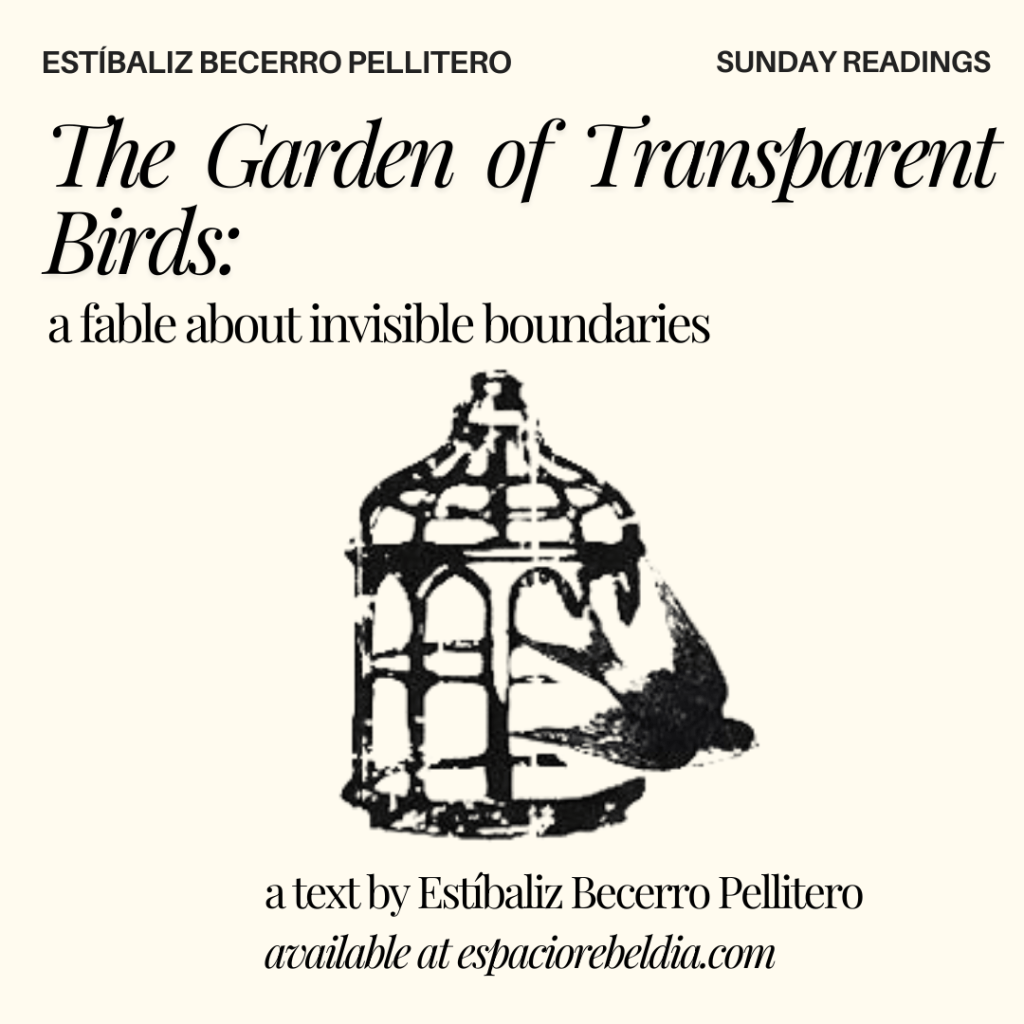
The Garden of Transparent Birds: a fable about invisible boundaries.
A text by Estíbaliz Becerro
Find Estíbaliz on Instagram:
My childhood was spent among the flowers in the garden that my grandmother tended so carefully. Not a single flower was left without the attention it deserved: carnations, roses, petunias, etc. The garden I was left to tend is very different from the one featured in a melancholic summer story from the first decade of the 21st century. There are gardens, like mine, that do not grow on the earth, but in the collective imagination. Elevated gardens, floating high above, sustained by tradition, custom, fear. One of them, invisible from below, is inhabited by the Transparent Birds.
These birds —more idea than animal— are born with wings made of desire, thought, and memory. Their transparency is not a defect, but a reflection of the place they occupy: they have learned not to be noticed, to fly without disturbing the wind, to sing in tones that do not disturb. From an early age, they are taught that their flight is free, but with a managed freedom. That they can reach the sky, as long as they do not ask what it is made of.
And yet, a ceiling hangs over that garden. A glass sky. Invisible to the naked eye, but relentlessly present. It does not cover everything: it allows you to see the stars, to dream of the blue, to imagine that the air is infinite. But it is there. And when a bird takes flight with strength and ambition, it discovers it in the cruelest way: with the sharp blow of the unspoken, with the frustration of what cannot be seen, but can be felt.
This glass ceiling is not a simple metaphor. It is the structural translation of inequality. It is the way in which the job world, academia, politics and society —historically designed by and for men— continues to hold back the advancement of those who do not fit the dominant mould. The figures confirm this: fewer women in positions of power, pay gaps, ceilings and also ‘sticky floors’ that prevent them from even taking off.
But let’s go back to the garden. Because, despite everything, some birds dare to fly. Some begin to look up with suspicion, to question the transparency of the world that was sold to them as fair. Some sing louder, not to please, but to name what hurts. And in that song, the crack is born.
Iridia was one of them. Not because she was the first, nor the strongest, but because she could no longer fly as if nothing else existed. A crack was her reward. A slit through which a new light filtered. And what happened next was inevitable: others saw her. Others followed her. And with every wing that grazed the glass, with every voice that rose, the ceiling vibrated.
What once seemed eternal began to crack.
But breaking the ceiling is not the end, it is just a new beginning. Because beyond it the air is different: lighter, but also more uncertain. Flying there requires learning new ways of being, of leading, of sharing the sky without repeating the rules of those who monopolised it for centuries.
And not everyone can do it alone. Many remain in the garden, not for lack of wings, but because of the invisible chains that still hold them back: unshared motherhood, structural poverty, learned fear, subtle —and sometimes brutal— violence that punishes those who dare. That is why the metaphor should not embellish the struggle or sugarcoat reality. It should illuminate it.
Each bird that breaks the glass makes way for others. Each crack that becomes visible forces the world to respond. Transparency, then, is no longer submission, but strategy: now they can see through the ceiling, map its cracks, plan their break.
Femininity —that word so often misunderstood, reduced or manipulated— is not a cage or a fixed essence. It is a way of being in the world with awareness, with a desire for freedom, with the fierce tenderness of someone who no longer asks for permission. It is not about flying like the birds of old, but about imagining a new sky, without ceilings or hierarchies, where one’s song does not silence the other, but elevates them.
Perhaps, in the end, revolution is less like a war and more like a flock: many different wings, flying together.
 ESPACIO REBELDIA
Deja un comentario